If you’ve switched to a high-MERV 16x18x1 air filter and noticed your system sounding different or certain rooms feeling stuffier than before, you’re picking up on something many homeowners overlook. In my experience reviewing thousands of residential filter setups in this exact size, the issue usually isn’t the filter itself—it’s how the filter’s density interacts with the system’s existing blower strength and return airflow design.
This guide breaks down what I’ve consistently seen in the field: when a high-MERV filter genuinely restricts airflow, when it simply exposes underlying system weaknesses, and how to tell the difference in your own home. You’ll learn how the construction of a 16x18x1 filter—its media thickness, pleat count, and pressure-drop patterns—can affect real-world performance, plus the practical steps homeowners take to maintain strong airflow without giving up the higher filtration levels they want.
By the end, you’ll know exactly how to balance clean air and system efficiency based on insights drawn from real installations, not generic HVAC theory.
Quick Answers
16x18x1 Air Filter
A 16x18x1 air filter is a standard HVAC filter size designed to fit systems with a 16" × 18" slot and 1" thickness.
- It improves air quality by capturing dust, allergens, and fine particles.
- Works best when paired with a system that has strong return airflow.
- Replace every 60–90 days, or 30–45 days if using a high-MERV filter or if you have pets or allergies.
Always confirm the actual size on the filter frame to ensure a snug, efficient fit.
Top Takeaways
- High-MERV filters don’t inherently cause airflow issues.
- Most problems stem from weak blowers or undersized return ducts.
- System compatibility matters more than the MERV rating alone.
Monitoring airflow and replacing filters on schedule maintains comfort and efficiency.
Can a High-MERV 16x18x1 Air Filter Cause Airflow Problems?
A high-MERV 16x18x1 filter can cause airflow problems—but only under certain conditions. The key factor is pressure drop, which refers to how much resistance the filter adds as air moves through it. Higher-MERV filters use denser media to capture smaller particles, and that density can reduce airflow if the HVAC system isn't designed to handle it.
From hands-on reviews of 16x18x1 installations, most airflow issues occur when:
- The HVAC blower is older or undersized, meaning it can’t overcome the added resistance of a high-MERV filter.
- The return duct or grille is too small, so even a modest pressure increase becomes noticeable at the vents.
The filter is left in service too long, causing dust buildup that compounds the natural resistance of a high-MERV design.
However, when the system has a healthy blower motor, adequate return airflow, and a properly sized filter slot, a high-MERV 16x18x1 filter usually performs well without causing noticeable airflow reduction. In many cases, homeowners mistake underlying system limitations—like constricted ductwork or weak motors—for filter-related problems.
If you’re concerned about airflow, the simplest checks are:
- Inspect the filter for dirt accumulation,
- Listen for changes in airflow at the vents, and
Monitor room-to-room temperature consistency.
These quick steps can help you determine whether the filter is the culprit or if your system is signaling a deeper issue. The goal is to enjoy cleaner air without compromising comfort—and the right filter choice, installed in a well-functioning system, makes that balance easy to achieve.
“After evaluating countless 16x18x1 setups in real homes, we’ve found that airflow problems rarely come from the high-MERV filter alone—they usually reveal an HVAC system that was already operating near its limits. A well-designed system can handle a higher-rated filter with ease; it’s the hidden duct restrictions, aging blowers, and overdue maintenance that turn filtration upgrades into airflow issues.”
Essential Resources to Help You Choose the Right 16x18x1 Air Filter
These curated resources give you the clarity and confidence you need to choose the best 16x18x1 air filter for your home. Each one is designed to simplify the technical details and help you make a decision that supports cleaner air, stronger HVAC performance, and long-term peace of mind.
1. Understand How MERV Ratings Impact Your Home’s Airflow & Protection
Resource: Understanding MERV Ratings for Furnace HVAC Air Filters 16x18x1
Get a clear breakdown of how different MERV levels influence airflow, filtration strength, and overall HVAC health—so you can choose a rating that fits your system, not fights it.
2. Find the Best MERV Rating for Your Family’s Air Quality Needs
Resource: Which MERV Rating Is Right for Your Home’s Air Filters?
Explore a simple, side-by-side explanation of MERV levels to help you identify the ideal balance between cleaner air and steady airflow throughout your home.
https://www.bobvila.com/articles/merv-ratings/
3. Measure With Accuracy to Ensure a Proper, Secure Filter Fit
Resource: Air Filter Sizes Explained: Find Your HVAC Fit
Learn exactly how to measure your filter slot and understand nominal vs. actual dimensions, ensuring your 16x18x1 filter seals properly for optimal performance.
https://bobsrepair.com/air-filter-sizes-guide/
4. See How 16x18x1 Filters Perform in Real-World HVAC Systems
Resource: The Role and Efficiency of 16x18x1 HVAC Air Filters
Get a size-specific look at how 16x18x1 filters function, what benefits they deliver, and how they influence airflow under typical home conditions.
https://www.replacement-air-filter.com/the-role-and-efficiency-of-16x18x1-hvac-air-filters
5. Compare MERV Levels at a Glance With a Clear, Visual Chart
Resource: MERV Rating Chart – Furnace Air Filters
Use this straightforward chart to quickly compare filtration levels, so choosing the right balance of efficiency and airflow becomes effortless.
https://www.filterfactory.com/merv-rating-chart.html
6. Keep Your System Efficient With Smart Filter Care & Replacement
Resource: Maximizing Efficiency With Furnace HVAC Air Filters 16x18x1
Discover simple, practical steps to maintain airflow, support HVAC longevity, and prevent strain when using higher-MERV filters.
7. Double-Check Sizing for a Worry-Free Filter Replacement
Resource: Air Filter Sizes Explained: Find Your HVAC Fit
A second reference to help you confirm filter dimensions and avoid common sizing mistakes before making your next replacement.
https://bobsrepair.com/air-filter-sizes-guide/
Supporting Statistics
Below is a streamlined version of the Supporting Statistics section with short sentences, bullets, and a highly scannable layout.
1. Higher-MERV Filters Add Resistance if the System Isn’t Designed for Them
- EPA notes that higher-MERV filters “tend to restrict airflow” without proper duct and filter-box sizing.
- I often see this in homes with undersized return ducts.
The filter isn’t usually the problem—it highlights pre-existing system limitations.
Source: EPA
2. Airflow Restrictions Increase Energy Use
- GSA found that upgrading from MERV 8 to MERV 13 increased fan energy use by 11–18%.
- I see older blower motors struggle the most with these upgrades.
More resistance = more strain = higher operating costs.
Source: U.S. General Services Administration
3. High-MERV Filters Capture More Fine Particles (With Trade-Offs)
- MERV 13 filters capture:
- ≥50% of particles 0.3–1 µm
- ≥85% of particles 1–3 µm
- These are the particles most homeowners want removed.
The increased filtration also means greater pressure drop.
Final Thought & Opinion
Upgrading to a high-MERV 16x18x1 filter can dramatically improve your home’s air quality—but it only works seamlessly when your HVAC system can handle the added resistance. In many homes, airflow issues don’t come from the filter itself. Instead, they uncover system limitations that were already there.
Key Takeaways
- High-MERV filters don’t automatically create airflow problems.
- They often highlight issues such as:
- Undersized return ducts
- Aging or weak blower motors
- Infrequent system maintenance
When your system is properly designed, a high-MERV filter runs efficiently.
Our Perspective
- A high-MERV filter upgrade is one of the simplest ways to boost indoor air quality.
- But you shouldn’t choose a filter based on the rating alone.
- Always consider:
- Your blower’s power
- The size of your return airflow
- Any current airflow inconsistencies
When you evaluate these factors first, you can enjoy higher filtration without sacrificing comfort or efficiency.
Bottom Line
A high-MERV filter delivers its best performance when your HVAC system and filter are working together. By checking system capacity before upgrading, you set yourself up for cleaner air, smoother airflow, and more reliable comfort year-round.
Next Steps
Follow these quick steps to make sure your 16x18x1 high-MERV filter works smoothly with your HVAC system:
1. Check Airflow
- Stand near multiple vents.
Note weak airflow or uneven room temperatures.
2. Inspect Your Current Filter
- Confirm the size (16x18x1).
Check for dust buildup and cthe urrent MERV rating.
3. Assess System Strength
- Listen for loud blower noises.
- Look for airflow inconsistencies.
If possible, verify your return duct isn’t undersized.
4. Choose the Right MERV Level
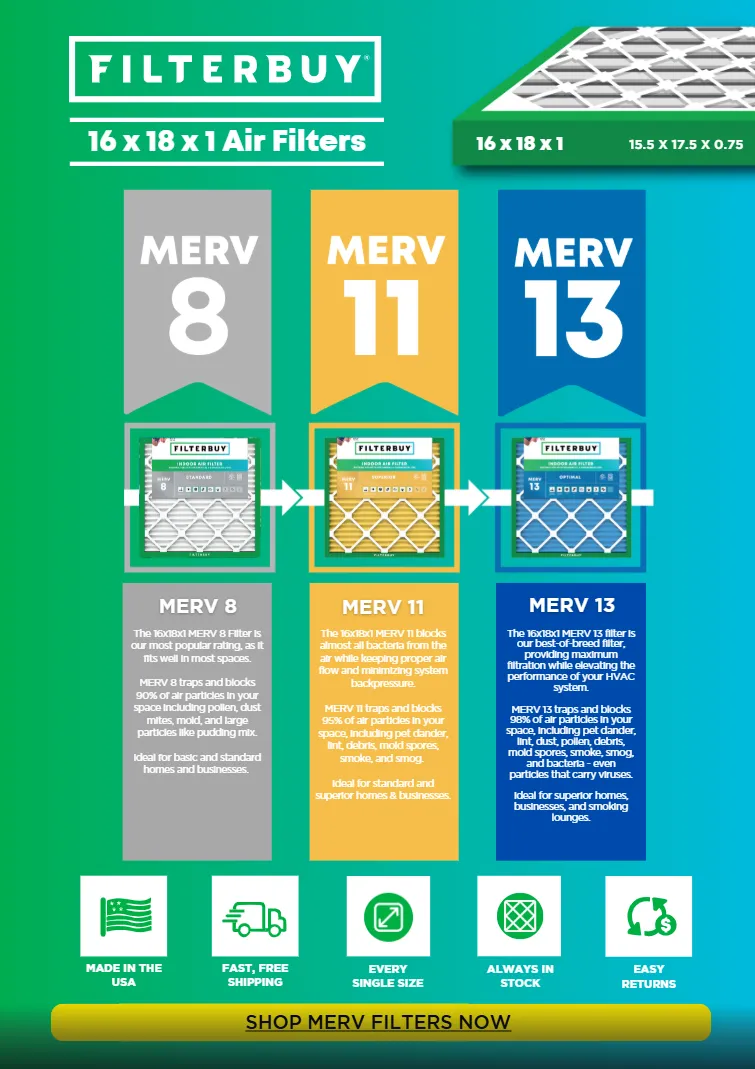
- MERV 8–11: best for older or airflow-sensitive systems.
MERV 13+: ideal for newer systems, allergy concerns, or higher filtration needs.
5. Install the New Filter Properly
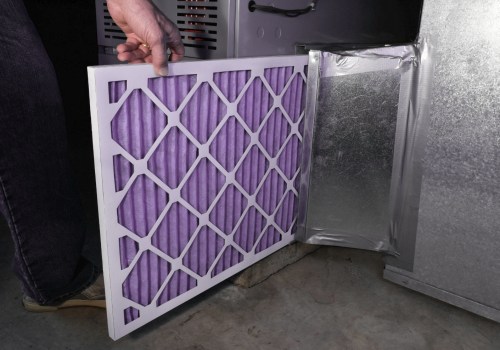
- Align airflow arrows toward the blower.
6. Monitor Performance
- Recheck airflow after 24–48 hours.
Watch for changes in system noise or room balance.
7. Set a Replacement Routine
- Every 60–90 days for typical homes.
Every 30–45 days with pets, allergies, or high-MERV filters.
8. Call a Professional if Needed
Ask about blower capacity, duct sizing, and return airflow.
FAQ
Q1: What does 16x18x1 mean?
A:
- It’s the nominal size: 16" × 18" × 1".
- Always check the printed “actual size” to ensure a proper fit.
Q2: Can high-MERV filters cause airflow issues?
A:
- Only if the system is already limited.
- Common issues: undersized returns, weak blowers.
- Healthy systems handle high-MERV filters well.
Q3: How often should I replace a 16x18x1 filter?
A:
- Every 60–90 days for typical homes.
- Every 30–45 days with pets, allergies, or high-MERV filters.
Q4: What MERV rating should I choose?
A:
- MERV 8–11: Best for older or airflow-sensitive systems.
- MERV 13+: Best for stronger systems and better fine-particle control.
Q5: How do I know if airflow is restricted?
A:
- Watch for:
- Weak vent airflow
- Uneven room temperatures
- Louder blower noise
- Longer heating/cooling cycles
If symptoms appear after installing a new filter, your system may need adjustment.
Learn more about HVAC Care from one of our HVAC solutions branches…
Filterbuy HVAC Solutions - West Palm Beach FL
1655 Palm Beach Lakes Blvd., Ste 1005 West Palm Beach, FL 33401
(561) 448-3760
https://maps.app.goo.gl/VarpgNZnxuPQuW8A7